
Introduction
The rapid evolution of technology has transformed how humans interact with machines. At the forefront of this transformation is MinMo, a revolutionary multimodal large language model (LLM) introduced by the FunAudioLLM team from Tongyi Lab, Alibaba Group. With approximately 8 billion parameters, MinMo redefines seamless voice interaction by offering real-time, natural, and human-like conversations between users and systems.
AI voice integration
Understanding MinMo’s Innovation
MinMo addresses several critical limitations that have been observed in earlier multimodal speech-text models, which have historically struggled with a variety of challenges that hinder their effectiveness and adaptability. One of the primary issues has been insufficient pre-training, where models were not exposed to a sufficiently diverse range of data prior to fine-tuning. This lack of comprehensive pre-training often resulted in models that were ill-equipped to generalize well across different contexts and speech patterns, leading to suboptimal performance in real-world applications.
Additionally, misaligned speech-text integration has been a significant hurdle in previous models. This misalignment refers to the inability of the system to effectively synchronize and correlate spoken language with its textual representation. Such discrepancies can lead to misunderstandings and inaccuracies in both comprehension and generation, ultimately affecting the user experience and the reliability of the model's outputs.
Furthermore, many earlier models faced limitations in data coverage, often relying on narrow datasets that did not encompass the vast array of linguistic variations, accents, and dialects present in human speech. This restricted data coverage meant that these models were less capable of handling the rich diversity of spoken language, which is essential for applications that aim to serve a global audience.
In contrast, MinMo takes a significant leap forward by leveraging an impressive 1.4 million hours of diverse speech data, which encompasses a wide range of accents, dialects, and contextual speech scenarios. This extensive dataset provides a robust foundation for the model, allowing it to learn from a rich tapestry of linguistic inputs and thereby enhancing its ability to understand and generate speech.
Moreover, MinMo employs a sophisticated training regimen that spans four distinct alignment stages: speech-to-text, text-to-speech, speech-to-speech, and duplex interaction. Each of these stages is meticulously designed to refine the model's capabilities at different junctures of the speech-text integration process. The speech-to-text stage focuses on accurately transcribing spoken language into written form, while the text-to-speech stage emphasizes the generation of natural-sounding speech from textual input. The speech-to-speech stage further enhances the model's ability to process spoken language in a conversational context, enabling seamless interactions. Finally, the duplex interaction stage allows for a more dynamic and responsive communication flow, where the model can engage in back-and-forth exchanges, simulating a more human-like conversational experience.
Through this comprehensive approach, MinMo not only addresses the shortcomings of its predecessors but also achieves state-of-the-art (SOTA) performance in both voice comprehension and generation. This advancement signifies a substantial improvement in the ability of multimodal models to understand and produce human-like speech, making MinMo a pivotal development in the evolution of speech-text integration technologies.
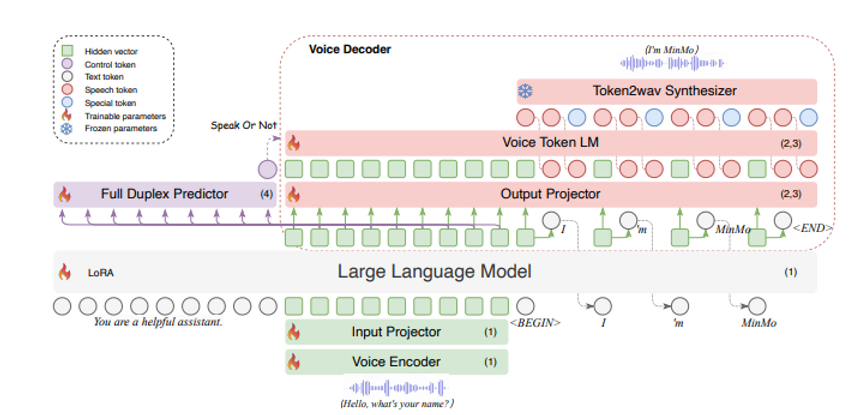
Minmo's overall architecture
Key Features of MinMo
Multitask Training: MinMo’s innovative training regimen encompasses a variety of advanced functionalities, including automatic speech recognition (ASR), speech translation, emotion recognition, and more. This comprehensive approach enables MinMo to deliver robust performance across a wide array of benchmarks and tasks. By integrating multiple capabilities into a single model, MinMo not only enhances the efficiency of processing but also improves the accuracy and reliability of the outputs generated. This multitasking ability allows users to engage with the system in diverse ways, whether through translating spoken language in real-time, recognizing emotional undertones in speech, or transcribing audio with high precision, thus making it a versatile tool for various applications in communication and interaction.
Instruction-Following Capabilities: One of the standout features of MinMo is its exceptional instruction-following capabilities, which allow it to support a wide range of nuanced speech styles, emotional expressions, dialects, and even the ability to mimic specific voices. This adaptability ensures that users receive responses that are not only contextually appropriate but also tailored to their individual preferences and needs. Whether a user requires a formal tone for business communication or a more casual style for friendly interactions, MinMo can adjust its output accordingly. Furthermore, this level of customization enhances user engagement and satisfaction, as the system can resonate more deeply with the unique characteristics of each user's speech and communication style.
Full-Duplex Interaction: In a significant advancement over traditional models, MinMo offers full-duplex interaction capabilities, enabling simultaneous two-way communication between the user and the system. This feature allows for a more natural conversational flow, as both parties can speak and listen at the same time, leading to a more dynamic and engaging interaction. With a remarkably low latency of just 800ms in practice, MinMo minimizes delays that can disrupt the flow of conversation, making it an ideal choice for applications requiring real-time dialogue, such as customer service, live translation, and interactive voice response systems. This innovative approach to interaction not only enhances user experience but also fosters a more intuitive and human-like communication environment.
Novel Voice Decoder: At the heart of MinMo’s impressive performance is its cutting-edge autoregressive streaming voice decoder, which is designed to ensure high-quality voice generation while maintaining structural simplicity and operational efficiency. This novel voice decoder allows for seamless streaming of audio output, producing clear and natural-sounding speech that closely mimics human voice characteristics. The efficiency of the decoder means that it can operate effectively even in resource-constrained environments, making it accessible for a wide range of devices and applications. By prioritizing both quality and efficiency, MinMo’s voice decoder not only enhances the overall user experience but also supports various use cases, from virtual assistants to interactive storytelling, ensuring that users receive a compelling auditory experience that is both engaging and easy to understand.
Performance Highlights
MinMo excels across multiple benchmarks:
Achieved SOTA in multilingual ASR, speech translation, and voice emotion recognition.
Demonstrated superior contextual biasing in speech recognition tasks.
Delivered high accuracy in speaker analysis and vocal sound classification.
The Future of Voice Interaction
MinMo represents a leap forward in making voice-based systems more intuitive and human-like. Its ability to integrate extensive speech data while preserving the capabilities of text-based LLMs opens up new possibilities for applications in customer support, education, healthcare, and more.
For more details, visit .